


The Hellenic Foundation for Book and Culture (HFBC) runs the Cavafy Museum as part of its activities abroad, under the responsibility of its Alexandria Branch.
The Hellenic Foundation for Book and Culture (HFBC) runs the Cavafy Museum, as part of its activities abroad, under the responsibility of its Alexandria Branch. The Museum was inaugurated in 1992 on the initiative of the historian and author Kostis Moskov (1939-1998), a gifted man of letters and science. The museum is known in Egypt as سيفاڤكلزنم – Cavafy’s House – and is housed in the apartment where Cavafy lived for 35 years. In the museum there are documents and exhibits illustrating the life and work of the poet.
Cavafy’s House in Alexandria
Can you imagine the small office where C. P. Cavafy wrote his poems? The balcony on which he dreamed of tomorrow and thought back on yesterday? The neighbourhood he walked around in the center of Alexandria? His apartment on the former Rue Lepsius?
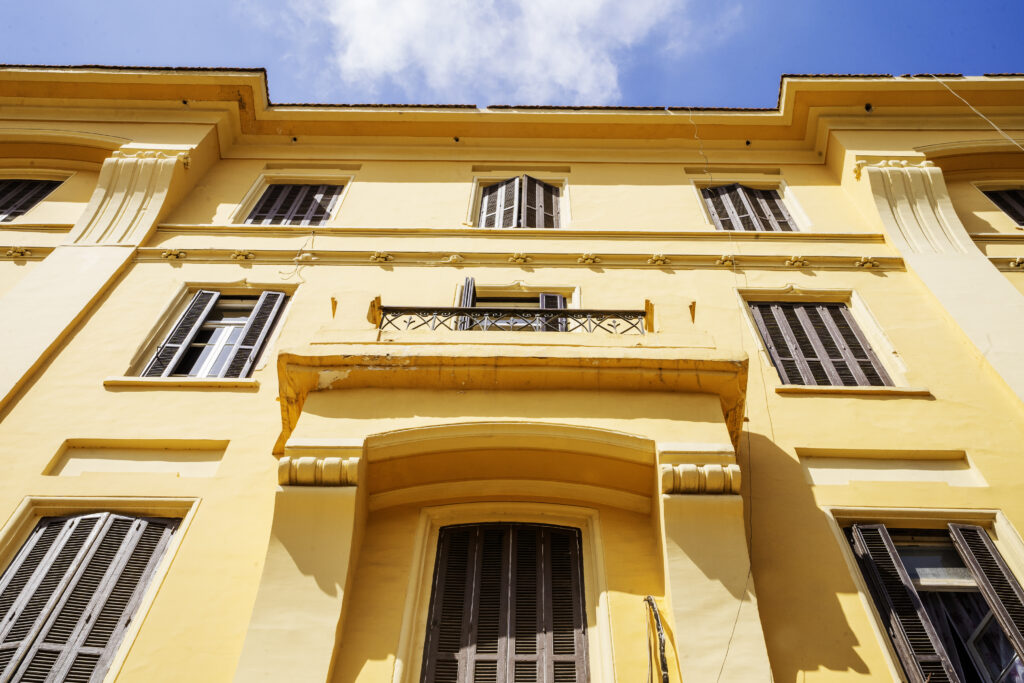
Starting with the acquisition of the Cavafy archive, its digitization, and its opening to the public and researchers, the Onassis Foundation, in collaboration with the Hellenic Foundation for Culture (whose successor is HFBC), undertook the restoration of the Cavafy House in Alexandria in early 2022, aiming to turn it into a hub for visitors from all over the world. In May 2024, the Cavafy House reopened its doors to the public. The apartment where C. P. Cavafy lived most of his life and created so many of the works that made him a universal poet has been restored and reconfigured in order to highlight the image of the residence as it was in the years the poet lived, to illuminate his relationship with the city of Alexandria and the impact of his work to this day, but also to transport us back in time.
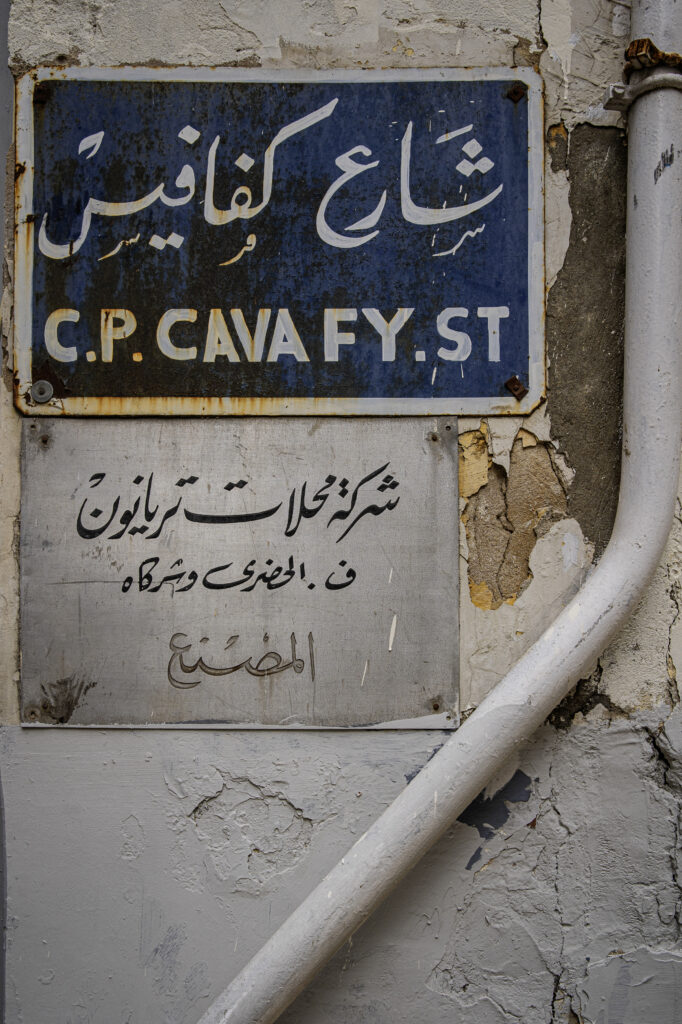
C. P. Cavafy moved to this apartment at what was then 10 Rue Lepsius (now 4 Rue C. P. Cavafy, formerly Rue Sharm El Shiekh) in 1907, together with his older brother Paul. The following year, Paul retired and moved permanently to France, to the town of Hyères, and from then on, the poet lived alone in this apartment. After his death, the building functioned as a boarding house named Amir, among other uses.
On November 16, 1992, on the initiative and efforts of the historian and writer Kostis Moskov, cultural attaché at the Greek Embassy in Cairo, and of Stratis Stratigakis, who also provided the funding, the Cavafy Museum was inaugurated in this space. Two years later the Stratis Tsirkas Room was shaped, with materials donated by the Stratis Tsirkas Society of Friends, dedicated to the acclaimed Egyptian Greek author. Tsirkas met C. P. Cavafy at a young age, and visited him in this apartment during the summer of 1930. Many years later he wrote two landmark works on the poet, Cavafy and his Era (1958) and The Political Cavafy (1971).
In this way, the Onassis Foundation has created a triad dedicated to the great poet. This includes two physical points of contact with him and his work: the Cavafy Archive in Plaka and the Cavafy House in Alexandria, on Rue Lepsius. The third meeting point is interactive and involves the fully digitized Cavafy archive.
Room Themes
The Universal Poet
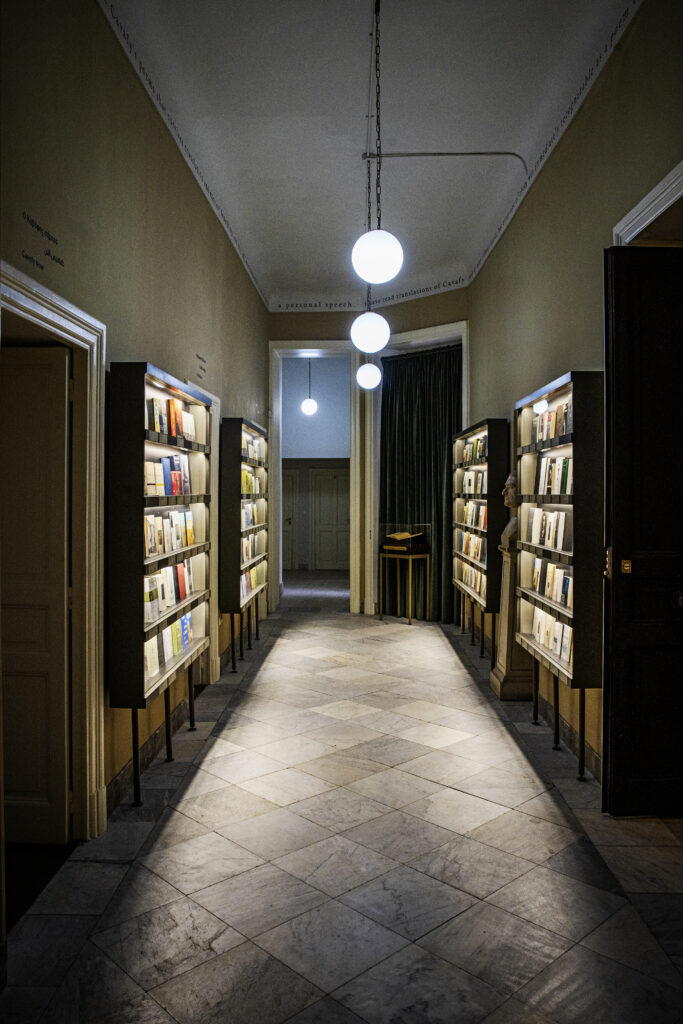
Universal and always relevant, C. P. Cavafy is one of the most translated Greek poets of his era. The impact of the Alexandrian poet’s work is demonstrated through a translation corpus encompassing his poetic and prose work and extending into more than thirty languages. The journey into the translation world of C. P. Cavafy begins with the first collected edition of his poems, which was published after his death in 1935, edited by Rica Singopoulos and illustrated by Takis Kalmouchos. This is copy 210 of 2,030 in total, on Vélin Madagascar-Lafuma paper.
“Alexandria Still”
Throughout his life, C. P. Cavafy conversed with Alexandria. The poet’s relationship with the city is illuminated through twenty-one landmarks related to his life and work placed on a reconstructed map of the 1920s. Some of these—like traces of the poet’s presence in the city—still exist in its urban landscape. At the same time, the life and work of C. P. Cavafy are presented through a timeline that outlines the historical context in which the man and the poet was shaped as he lived and dreamed in Alexandria.
Genealogy and Personal Life
The lineage of the poet was a subject that concerned him greatly, as evidenced by the archival documents “Genealogical Gossip or Various Bits of the History of Our Father’s and Mother’s Family Thrown Together” and “Genealogical Tableau of the Cavafy Family.” The passports of his parents, Hariclia and Peter John, are indeed an indisputable testament to the family’s cosmopolitan and hybrid social identity: a combination of Phanariot origins, multinational business ventures, and Anglo-Greek cultural orientation. The poet’s personal life unfolds through a selection of archival documents, including diary entries, letter correspondence, ephemera, professional documents, and books from his library.
Salon, a Recreation
A recreation of the poet’s living room, where C. P. Cavafy welcomed his guests, such as Nikos Kazantzakis, Myrtiotissa, Kostas Ouranis, Filippo Tommaso Marinetti, and E. M. Forster. Some of the furniture in the space is a replica of those originally owned by the poet, while other objects have been maintained from the original furnishings of the Cavafy House when it was inaugurated in 1992 under the initiative of Kostis Moskov. A selection of books relevant to those preserved in the poet’s library can be found on the shelves.[Text Wrapping Break]
Cavafy Now
How does the poet converse with contemporary visual and film artists? How are the work, the figure of the poet, and the Cavafian environment of Alexandria portrayed? A series of eight video works, commissioned by the Onassis Foundation in the framework of the “Archive of Desire” festival in New York in the spring of 2023, are presented in the space of the Cavafy House. Among them are works by great visual artists such as Yannis Kyriakides and Farida El Gazzar.
In Dialogue
The walls of the room are endowed with a selection of archival documents of correspondence between C. P. Cavafy and his contemporaries, as well as newspaper clippings, all of them shedding light on the network of contacts, the appreciation of the poet’s literary value, and the recognition by his peers from all over the world. In addition, archival documents reveal the poet’s stance and identity as Egyptian Greek. At the main table, eight works by Greek and foreign authors and artists detail the reception and enduring impact of the Cavafian work as it emerges in the works of others.
The Archive
C. P. Cavafy compiled and archived his work on a systematic basis, hence creating a unique literary and personal archive. The Cavafy archive includes manuscripts of his poems, hand-compiled printed editions, prose literary texts, articles, studies, and notes by the poet, as well as extensive letter correspondence, texts, and photographs. The Cavafy archive came under the management of the Onassis Foundation at the end of 2012, a development that safeguarded its preservation in Greece while preventing its potential fragmentation. Following its digitization and full documentation, the digital collection of the Cavafy archive was published in March 2019 in Greek and English, rendering the archive accessible to all. In November 2023, the Onassis Foundation secured a permanent space for the Cavafy Archive on 16b Frynichou Street in Plaka, open to the public and researchers alike.
The House
A selection of snapshots from the history of the apartment where the poet lived from 1907 to the end of his life, as it has been shaped from 1933 to the present day. The space of the apartment is revealed as an exhibit in need of preservation and restoration, an initiative that the Onassis Foundation has undertaken in collaboration with the Hellenic Foundation for Culture. In the spring of 2024, the restored Cavafy House opens its doors to the public anew.
Academic Advisors for the Cavafy House Exhibition
Hala Halim
Associate Professor in the Departments of Comparative Literature and Middle Eastern Studies, New York University, USA
Peter Jeffreys
Associate Professor of English Literature, Suffolk University, Boston, USA
Louisa Karapidaki
Museologist, Centre for the Study of Greek Folklore, Academy of Athens
Alexander Kazamias
Associate Professor of Political Science, School of Arts and Humanities, Coventry University, UK
Gonda Van Steen
Professor in the Korais Chair of Modern Greek and Byzantine History, Language and Literature, King’s College London, UK
Mohamed Adel Dessouki
Consultant in Urban History, Arab Academy of Science and Technology, Egypt
Exhibition Credits
Flux-office:
Eva Manidaki & Thanassis Demiris
Design & Curation
Eleni Arapostathi
Associate
Katerina Vlahbey
Graphic Design
Karren Emmerich
Translations & Editing in English
Vassilis Douvitsas
Translations & Editing in Greek
Khaled Raouf
Translations in Arabic
Roni Bou Saba
Proofreading in Arabic
Effie Tsiotsiou, Marianna Christofi, Eleanna Semitelou
Project Coordination
CODEP LTD EGYPT
Building Restoration Contractor
Babis Lengas
Reproduction of Archival documents
MOVEART
Hanging of Artworks
Cluster
Production and supervision of installation of special structures and display units
Cavafy House
(4, C. Cavafy Str.)
2nd Floor
Tuesday-Sunday, 10:00-17:00

Photographs: Andreas Simopoulos


